Folding, adaptable wings are—along with new engines—among the most important levers for more sustainable flight. With the Boeing 777X, folding wings are now finding their way into passenger aviation for the first time.
More efficient flight with folding wings
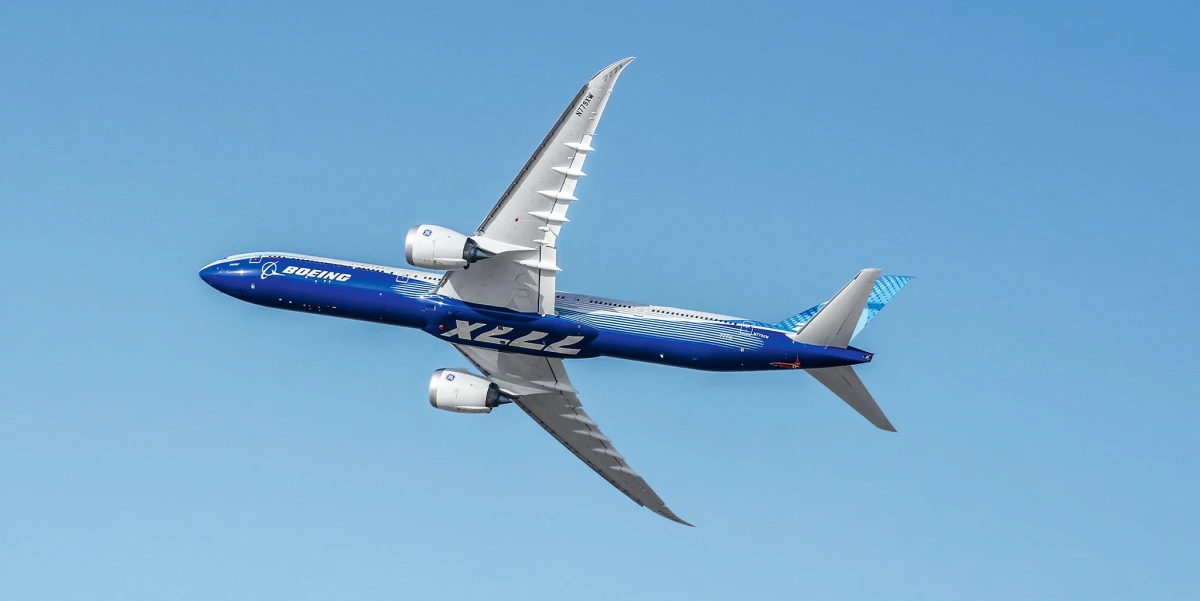
For almost as long as aircraft have existed, one approach has held sway: When space is tight on the ground, wings are designed so that they can be folded up. Because nothing takes up space like a pair of sweeping wings—but without them, no aircraft could ever leave the ground. Folding wings were developed for naval aviation, especially for aircraft on aircraft carriers, where parking space is at more of a premium than anywhere else. Back in 1913, the Short Folder biplane became the first to feature wings that could be folded back. This was followed in 1935 by the Douglas Devastator, which offered pilots the convenience of being able to fold the wings hydraulically at the touch of a button right from the cockpit. Now, this idea is also making its debut in modern aviation: The Boeing 777-9 and its smaller sister, the 777-8, will be the first passenger aircraft with wingtips that fold upward.
The wingtips fold up after landing
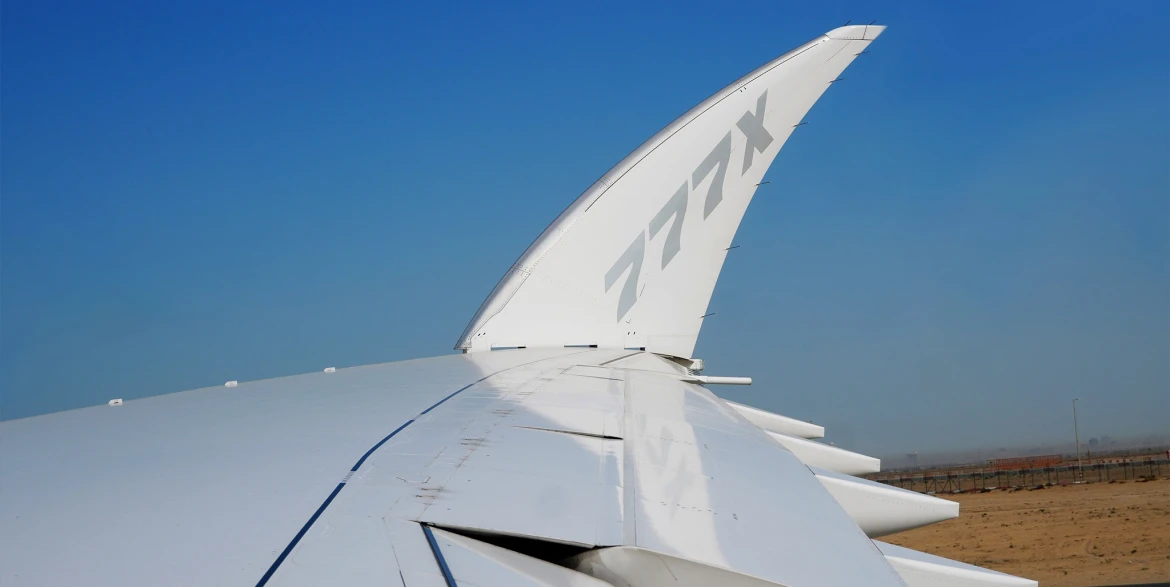
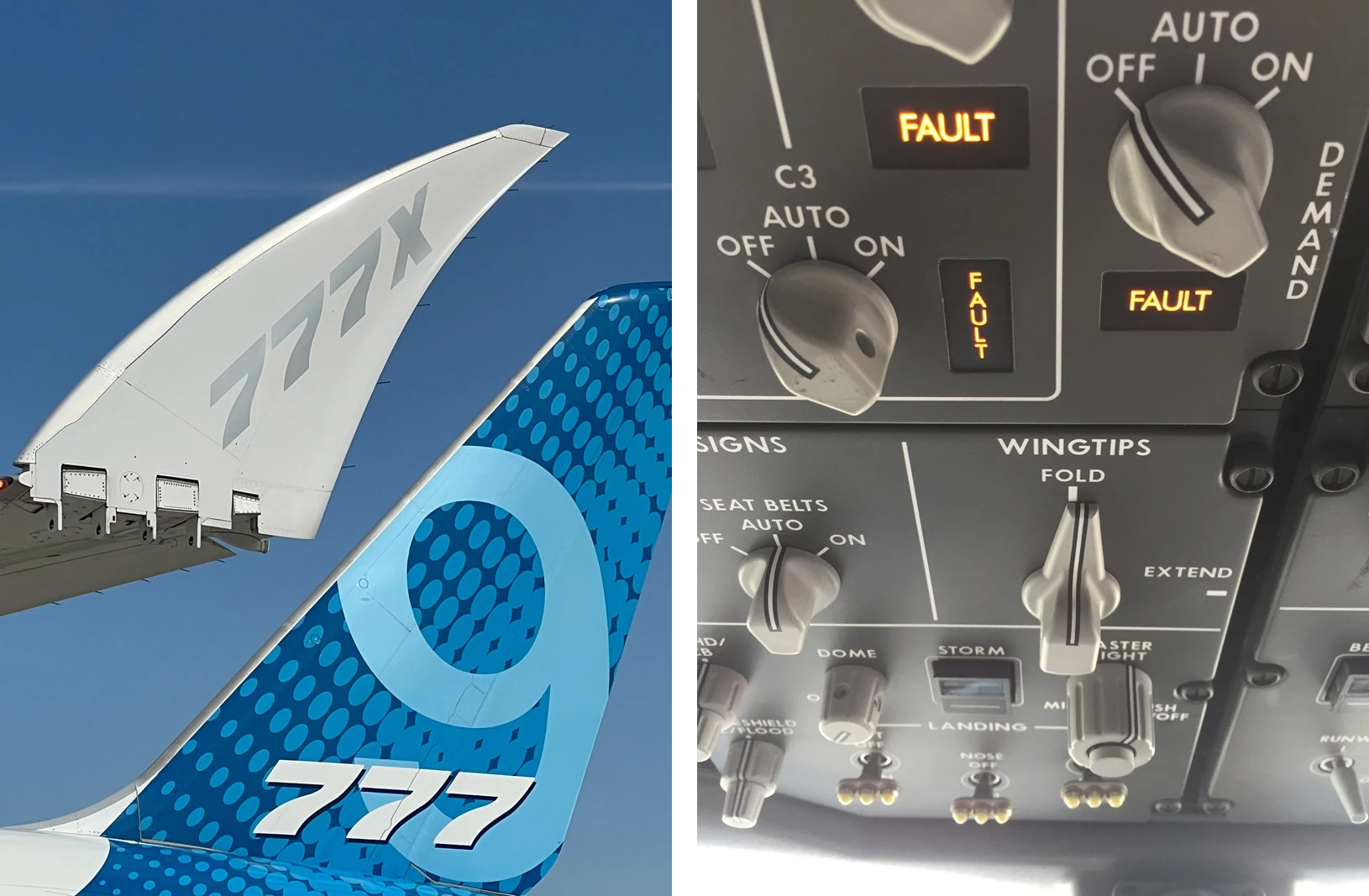
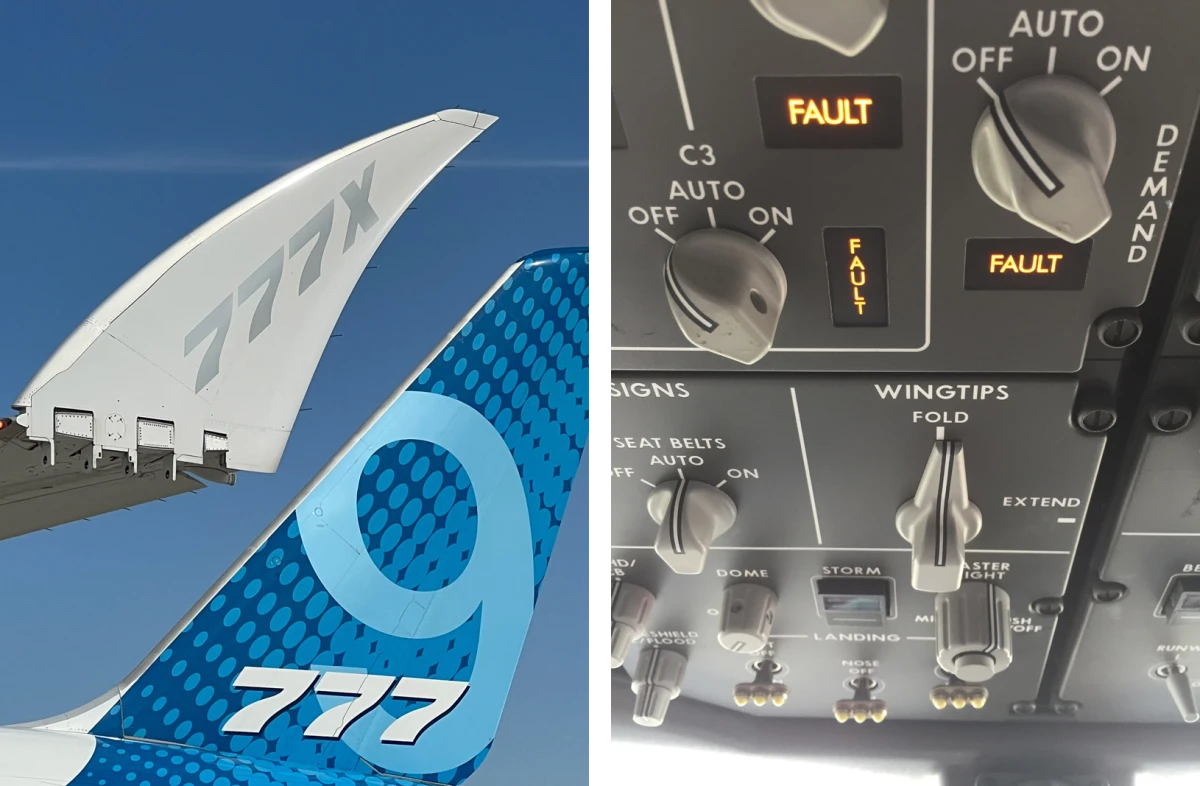
After landing, the outer 3.50 meters of both wings will automatically fold up as soon as the speed has dropped to 50 knots (92 km/h). The reason is simple: With its full wingspan of 71.75 meters, the 777-9 would fall into the largest aircraft category, known as Code F—the same as jumbos such as the Boeing 747 or the Airbus A380. However, many airports have hardly any parking space left for this size class, and two such aircraft wouldn’t be able to pass each other on narrow taxiways. So instead, this mechanism converts the 777-9 into a smaller Code E aircraft—by reducing its wingspan to “only” 64.80 meters.

©Andreas Spaeth
©Andreas Spaeth
©Andreas Spaeth
Before starting the takeoff run, the pilots operate a rotary switch marked Wingtips, located at the top of the center console in the cockpit, moving it from Fold to Extend—and the tips slowly fold down hydraulically within around 20 seconds. Fastening bolts then engage to physically prevent the wings from folding up unintentionally in flight. In addition, the electrical system in this area is cut to ensure that it doesn’t receive any electricity.
At Boeing, this idea has been around for some time: “It’s something that was considered for the original Boeing 777 in the 1990s,” recalls Claus Zeumer, aircraft analyst at MTU Aero Engines in Munich. “With standard wings, the aircraft fit Code E gates; with folding wings, it could have served Code D gates. For that, though, relatively large sections of the wing would have had to fold up—including areas of the ailerons. This made the design complex and thus ultimately unattractive.”
The wingspan of the Boeing 777-9 has grown by over ten meters
When the first versions of this twinjet went into service in 1995, they had a wingspan of just under 61 meters; the 777-300ER in widespread use today fits precisely within the limit of the 64.80 meters required for Code E aircraft. Now the 777-9 has grown by almost another seven meters—and that’s no coincidence. “A large wingspan is one of the most important factors for increasing the efficiency of future commercial aircraft,” Zeumer says. “It takes a large wingspan to reduce lift-induced drag, which is primarily a factor of an aircraft’s weight and wingspan.”
Wings that are long and slim and have a high aspect ratio offer excellent prospects for double-digit efficiency gains. “New wings ought to deliver as much of a reduction in fuel consumption—and thus in CO2 emissions—as the next generation of engines will achieve,” says Sue Partridge, Head of the Airbus Wing of Tomorrow program, which is working on the development of new wing technologies in Bristol, UK. But such optimized wings come with their own challenges.

©Airbus SAS 2025
“New wings ought to deliver as much of a reduction in fuel consumption—and thus in CO2 emissions—as the next generation of engines will achieve.”
Sue Partridge
Head of the Airbus Wing of Tomorrow program
Learning from the albatross: Free-swinging wingtips in flight
“The problem is that these longer, thinner wings can’t be allowed to get too heavy. Longer wings are heavier per se, and this additional weight threatens to cancel out the advantages of the longer wingspan,” Zeumer says. “That calls for technologies that can reduce structural loads.” One such technology is folding wings that are adjustable in flight—and Airbus will be testing the principle for the first time in 2026. For the project, an Airbus subsidiary called Airbus UpNext acquired a production model of the Cessna Citation VII business jet; after initial flight tests in its original configuration, the team removed the existing wings with their 16-meter wingspan.
As part of extensive conversion work, these were replaced by new wings that were four meters longer, much more slender, and had a higher aspect ratio. The key to their success was that the outer third of both wings can be folded up to save space on the ground, and can also be released in flight thanks to semi-aeroelastic hinges. This allows the wingtips to swing up and down freely—much like the albatross, a bird that achieves incredible feats of flying by flexibly adapting the tips of its elongated wings to the prevailing aerodynamic conditions during flight.
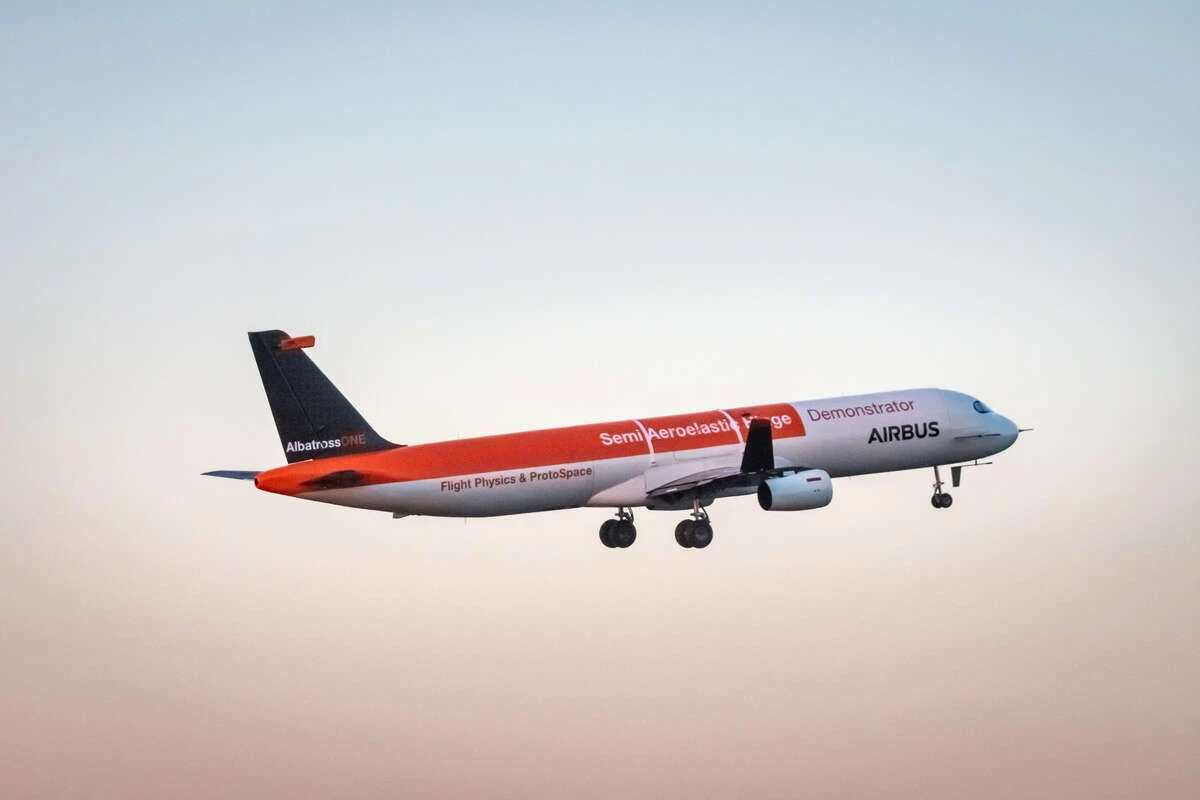
On board the test aircraft, lidar sensors detect turbulence and gusts of wind and respond by unlocking the hinges. The freely movable wingtips then reduce the loads that would otherwise act on the wing roots. This allows a more lightweight design for the entire wing structure—and the resulting considerable weight reduction, together with the efficiency gain of the extended wings, is set to shave up to 10 percent off fuel consumption. Airbus already demonstrated this principle in 2020 as part of the AlbatrossONE test program, using a remote-controlled model aircraft based on a modified A320.
©Airbus
AlbatrossONE in flight: Lidar sensors detect turbulence and activate freely moving wingtips—reducing loads, lowering structural weight, and potentially saving up to 10 percent fuel.
Angled wings reduce the load on the wing and airframe
“If you already have a joint in the wing to fold it up when the aircraft is on the ground, then you can integrate a mechanism that automatically angles the outer wing in strong gusts during flight,” Zeumer says. “That lets us greatly reduce the lift on the outer wing—which also reduces the bending load on the wing.” Relieving a wing in this way opens the door to building wings that are lighter and therefore more efficient. “The important thing is to keep the longer, slimmer wing’s weight within reasonable limits. If it’s too heavy, that cancels out the efficiency benefits of the greater wingspan,” he adds.
Airbus UpNext plans to carry out test flights with its converted Citation jet remotely and without a pilot on board. That way, it can sidestep lengthy approval procedures and push the technology to its limits during the test campaign. In essence, the test aircraft serves as a scaled-down version of a future next-generation narrowbody aircraft. At full scale, its wingspan would be around 50 meters—comparable to that of the Boeing 787. By contrast, today’s medium-haul aircraft such as the A320neo and Boeing 737-MAX families have a wingspan of just under 36 meters. “The wing length of these aircraft is limited by the ground infrastructure, so it’s a bit shorter than would be ideal for fuel consumption. We can see this by comparing them to the much smaller but more modern Embraer E195 E2, which also has a wingspan of 35.1 meters despite its smaller size,” Zeumer says.
Airbus is currently investigating wing lengths of between 45 and 52 meters—dimensions that are out of the question for most gates on the aprons of today’s airports. “The next generation of single-aisle aircraft will definitely have folding wings,” Zeumer says. “We’ll have to wait and see whether the folding mechanism will also be used in flight for load reduction.”