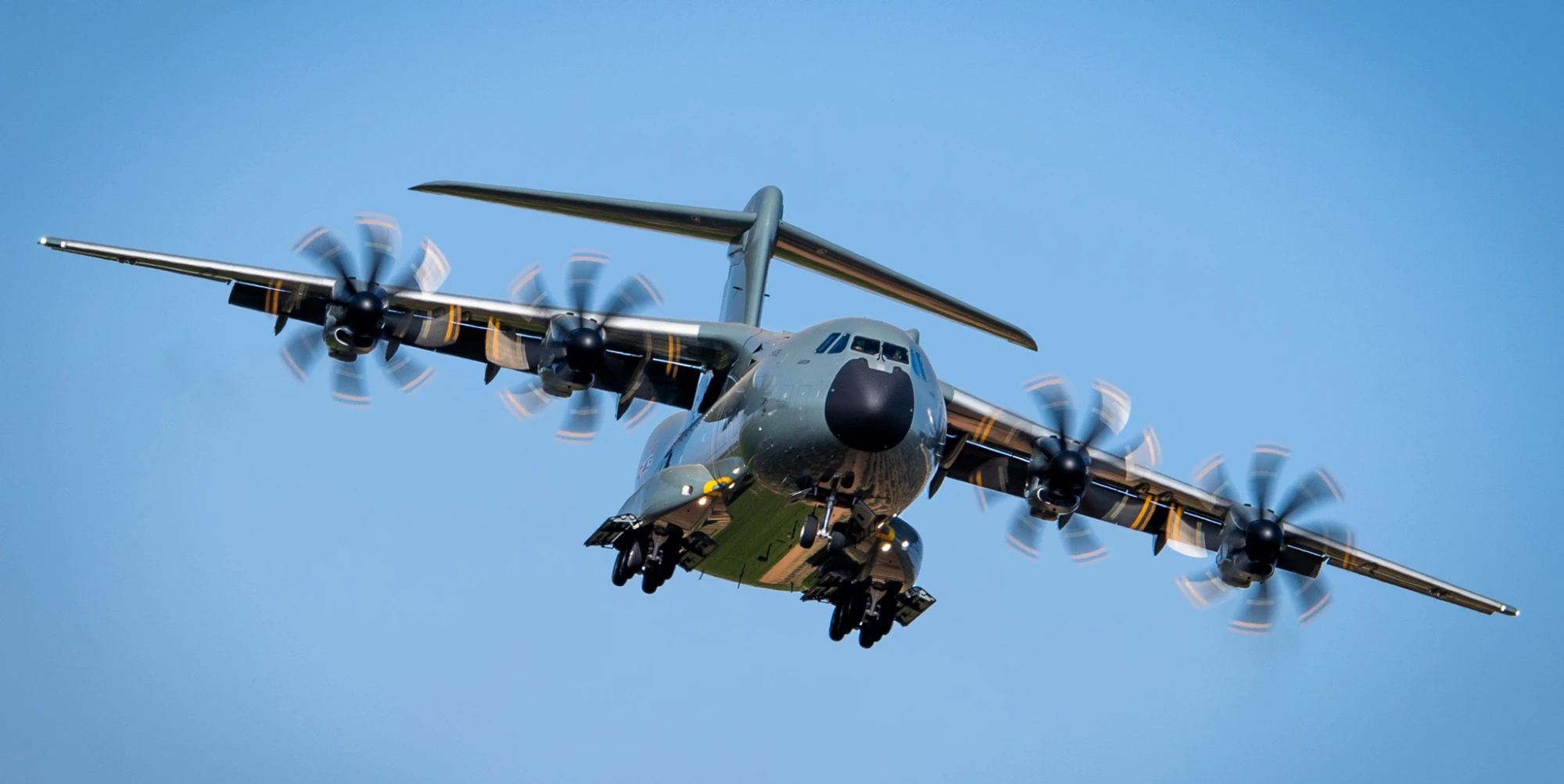
The European A400M transport aircraft is a real all-around talent: it combines capabilities for evacuations, troop transport, medical flights, and air refueling in a single system.
Airbus A400M – modern military transporter and all-around talent
- Boeing 747: Queen of the Skies
- The Boeing 737: How a simple jet revolutionized aviation
- Airbus A400M – modern military transporter and all-around talent
- Airbus A220 – The innovative medium-haul jet from Canada
- Boeing 777X – the largest twin-engine jet in the world
- Airbus A321XLR: A new chapter for aviation
- The Airbus A380 – the world’s largest passenger aircraft
- Airbus A319 – a small aircraft for a wide range of tasks
- Airbus A320 – a medium-haul bestseller for almost 40 years
- Embraer E-Jet E2 – A game changer for regional routes
- Boeing 787 – into the 21st century with the Dreamliner
Getting the Airbus A400M ready to enter service—tailored to the requirements of the air forces in seven Western European nations and Turkey—was a long and difficult road. When development began in 2000, Airbus was already hard at work on the world’s largest passenger aircraft, the A380; now the company had to juggle two mammoth tasks at once. Both projects presented Airbus with unprecedented challenges—financial, technical, and political.
This was the first time that Airbus had developed a turboprop aircraft, and was also its first foray into the field of purely military projects. On top of that, it had to integrate a completely redesigned European engine and at the same time reconcile the different requirements of various air forces. The first A400Ms were delivered to the French Air Force in 2013; the German Air Force received its first aircraft on December 18, 2014. Today, some ten years later, one thing is certain: the A400M is an indispensable part of military aviation. It offers twice the payload and range of its predecessors—a true quantum leap.
The military transporter has already proven itself time and again in crises; for instance, during the evacuation from Kabul in 2021 and while conducting earthquake relief in Turkey in 2023. During the ten-day rescue mission on unlit runways at Kabul Airport alone, the A400M brought a total of 5,347 people to safety in the German Armed Forces’ largest evacuation operation to date. The A400M was deployed again in June 2025, when the Bundeswehr evacuated German nationals from Israel during an Iranian attack. This aircraft’s ability to operate quickly and reliably under immense time pressure and in uncertain situations makes it a key instrument of Germany’s crisis response capability.
In April 2026, the Air Force took delivery of its 53rd and, for the time being, final A400M. By the end of 2024, the Air Force had already logged over 50,000 flight hours with the aircraft in nearly every type of Bundeswehr mission. In June 2026, following the earthquake in Venezuela, five A400Ms flew personnel and relief supplies to the crisis area; in July 2026, a converted French A400M served as a firefighting aircraft during the devastating wildfires in the country.

©Bundeswehr/Jane Schmidt
©Bundeswehr/Jane Schmidt
©Bundeswehr/Jane Schmidt
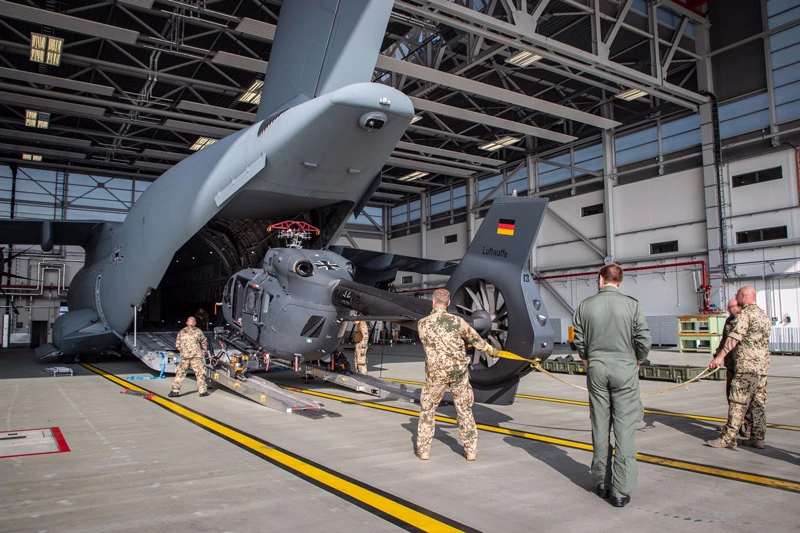
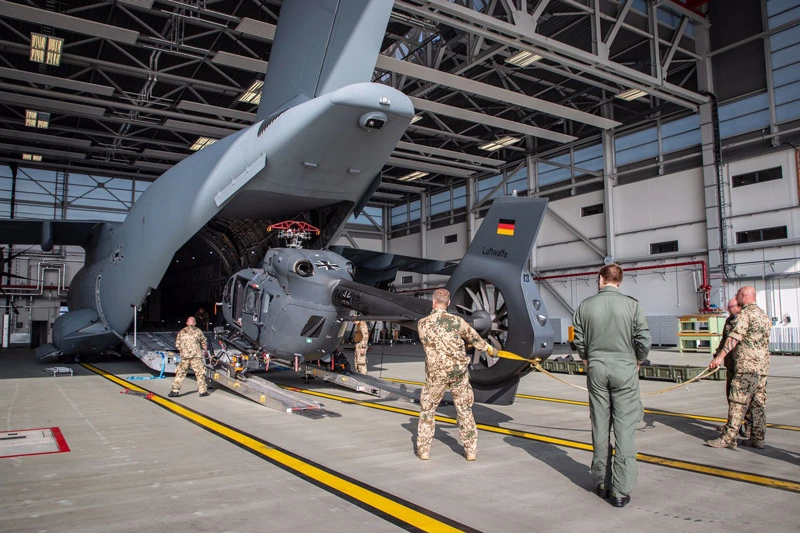
A H145M LUH SOF helicopter is loaded into an A400M—demonstrating the German Air Force’s high flexibility and transport capability during complex evacuation operations.
©AIRBUS 2013 / Alexandre Doumenjou
©AIRBUS 2013 / Alexandre Doumenjou
©AIRBUS 2013 / Alexandre Doumenjou
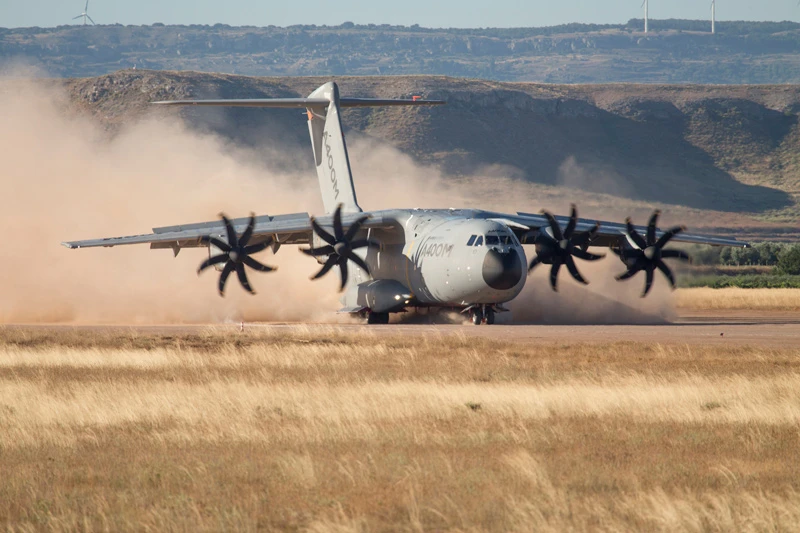
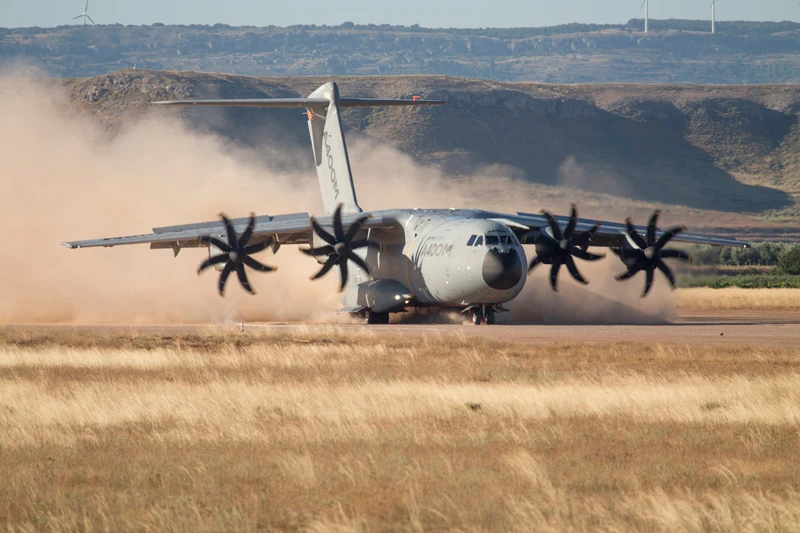
The A400M can take off and land even on gravel runways or the beach.
Airbus A400M – Facts, figures, dates
-
The A400M can transport up to 37 metric tons of freight over distances of some 3,000 kilometers. In tactical use, the guaranteed payload is 25 metric tons. Examples of what the aircraft can load via its drive-on rear ramp range from a medium-sized NH90 transport helicopter to a Puma infantry fighting vehicle or up to six Wolf infantry utility vehicles.
-
The cargo hold of the A400M is 17.70 meters long, 4 meters high, and 3.85 meters wide. It offers space for up to 116 fully equipped soldiers plus up to nine standard military pallets. On medevac missions, the aircraft serves as a flying intensive care unit capable of accommodating up to 66 NATO-standard medical stretchers and a 25-strong medical team. During the evacuation from Kabul, in some instances up to 213 people were transported simultaneously on the floor of the cargo hold—secured with safety belts.
-
A total of 178 aircraft were on order by the end of July 2026, of which 138 have already been delivered to the participating nations—including 53 to the German Armed Forces. France currently operates 25 A400Ms, the United Kingdom 22, Spain 14, and Turkey 10. Four other air forces—including those of Kazakhstan and Malaysia—also use the military transporter. A contract signed at the Paris Air Show in June 2025 secures the production of the A400M until at least spring 2029 and confirms the partner nations’ long-term confidence in the program.
©Airbus Defence and Space SAU 2025
©Airbus Defence and Space SAU 2025
©Airbus Defence and Space SAU 2025
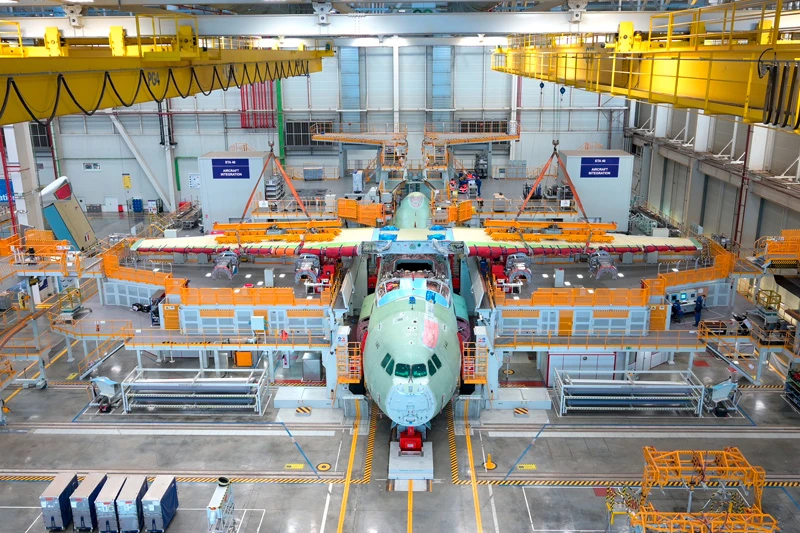
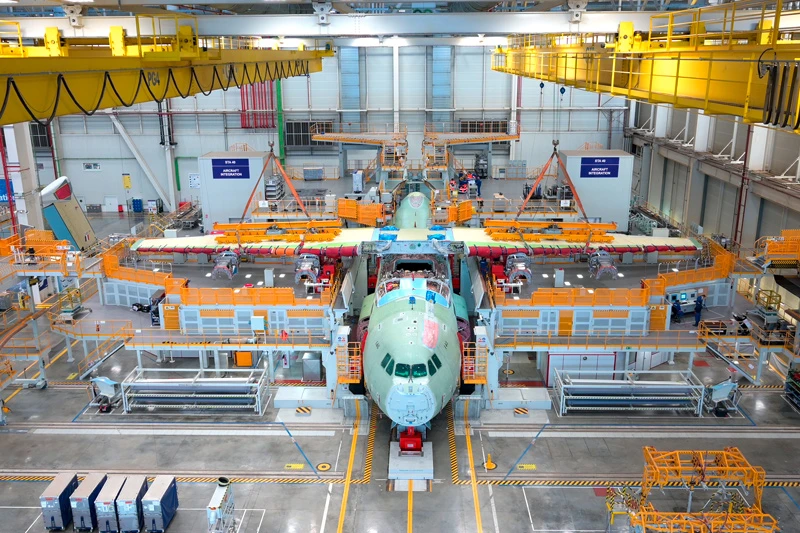
By the end of 2024, a total of 178 A400M aircraft had been ordered, with 131 already delivered—including 47 to the German Armed Forces.
©Bundeswehr/Christian Timmig
©Bundeswehr/Christian Timmig
©Bundeswehr/Christian Timmig
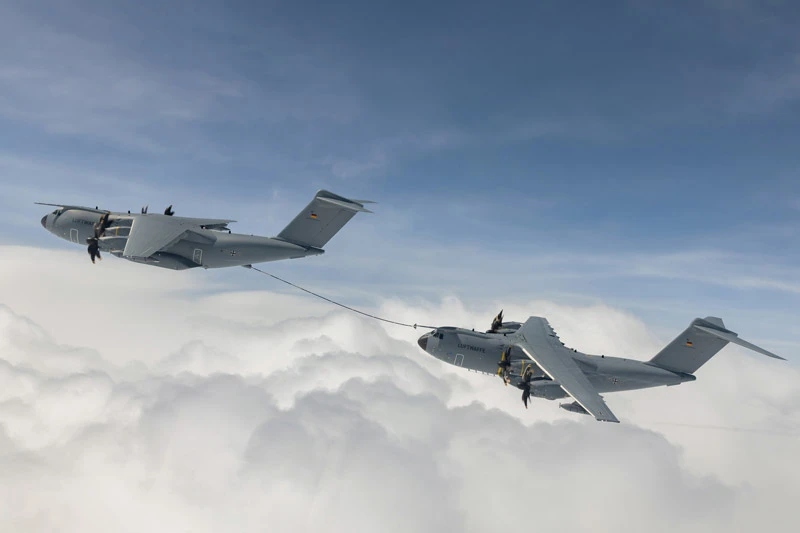
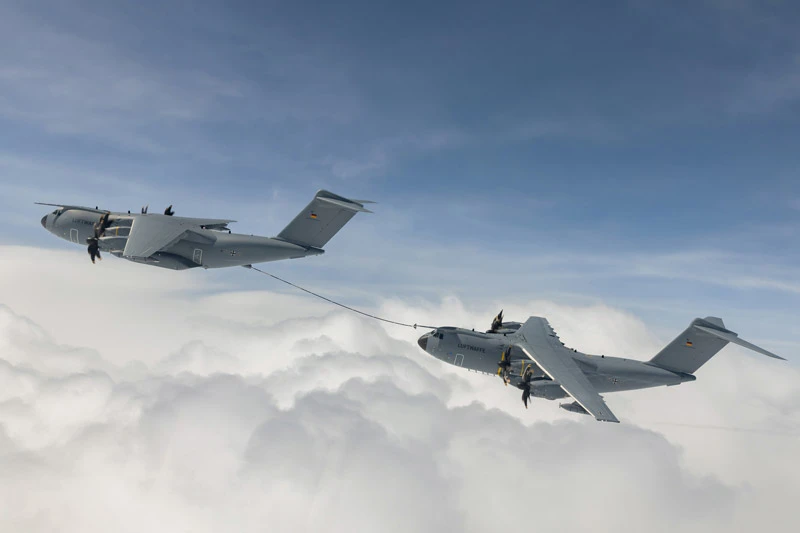
The A400M as an airborne tanker: Other aircraft, such as the Eurofighter, can dock with the A400M in flight and refuel at speeds exceeding 500 kilometers per hour.
-
The A400M is versatile: it can perform low-altitude flights as well as long-haul flights in commercial air corridors at altitudes of up to 12,000 meters. Back in 2015, it completed a transatlantic flight from Ramstein, Germany, to Washington, D.C., in just one day. By comparison, its predecessor, the Transall C-160, took three days to fly the same route.
-
In 2022, an A400M circumnavigated the globe—a first for the European military transporter. It took just 64 flight hours to cover a distance of some 46,000 kilometers. While crossing the Pacific Ocean, its only stops were in Papeete on Tahiti and on Easter Island.
-
Germany is the first country to use the A400M as a tanker aircraft—for aerial refueling of fighter jets and other A400Ms.
-
The A400M also acts as an “angel of the air”—for example, in February 2023, when three aircraft transported a total of 394 metric tons of relief supplies after the devastating earthquake in Turkey. That same year, the German Air Force deployed an A400M for an airdrop over Gaza: in the course of 21 flights, it dropped 430 pallets carrying a total of 220 metric tons of relief supplies for the civilian population.
-
Airbus has opened a production site in Seville, southern Spain, specifically to produce the A400M.
-
The A400M has appeared in several feature films, including “Mission: Impossible – Rogue Nation,” where lead actor Tom Cruise was strapped to the outside of the aircraft during takeoff.
Airbus A400M
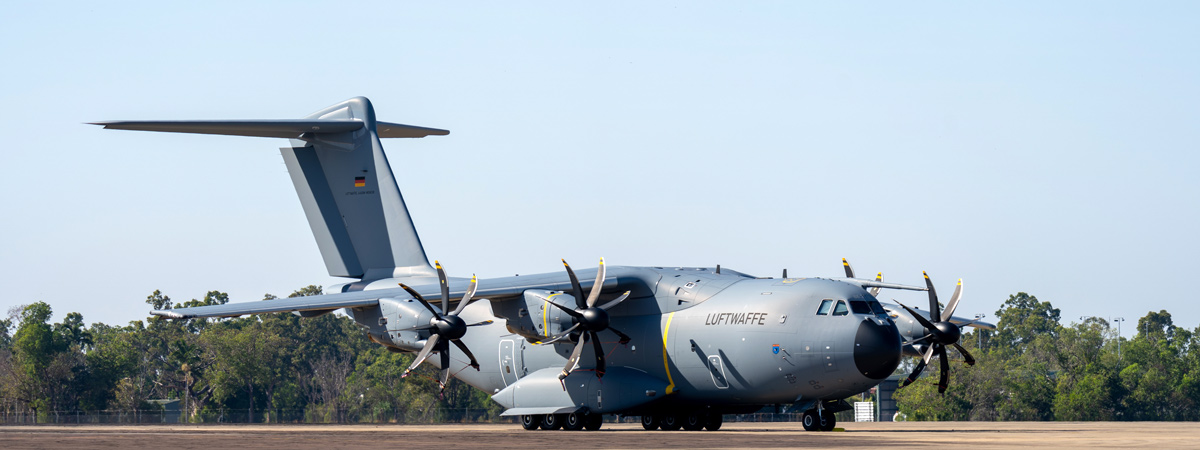
Airbus A400M
- Type:
- Military transporter, four-engine shoulder-wing aircraft
- Manufacturer/origin:
- Airbus Defence and Space, Germany/Spain
- Maiden flight:
- December 11, 2009
- Entry into service:
- August 1, 2013
- Produced:
- 2010–today
- Number built:
- 138 delivered by July 2026
- Length:
- 45.10 meters
- Wingspan:
- 42.36 meters
- Range:
- 3,300 km with max. payload, 6,390 km with 20 metric tons payload
- Cruising speed:
- 555 km/h at sea level, 750 km/h at cruising altitude
- Seats/payload:
- 116 soldiers with equipment / 37 metric tons
You may also be interested in:
The A400M engine: the TP400-D6
To meet the A400M’s unique requirements, the TP400-D6 is characterized by its advanced aerodynamics and component design, low fuel consumption, low weight, and efficiency across a broad operating range encompassing everything from prolonged low-altitude flights to high cruising speeds. It also features integrated engine and propeller control.
MTU developed the TP400-D6 military turboprop engine together with ITP Aero, Rolls-Royce, and Safran Aircraft Engines. The Europrop International (EPI) consortium was founded to manage engine development, manufacture, and support. MTU is responsible for the TP400-D6’s intermediate-pressure compressor, intermediate-pressure turbine, and intermediate-pressure shaft, and it is also involved in the control system.
The TP400-D6, the powerful heart of the A400M military transport aircraft, reached an impressive milestone in early 2026: the engines of this type have now completed more than one million flight hours. Since the start of the program, final assembly of all new engines for all air forces and export customers has taken place in Munich. This is followed by road transport from there to Ludwigsfelde, which is home to the world’s only production test stand for the A400M engines.
TP400-D6
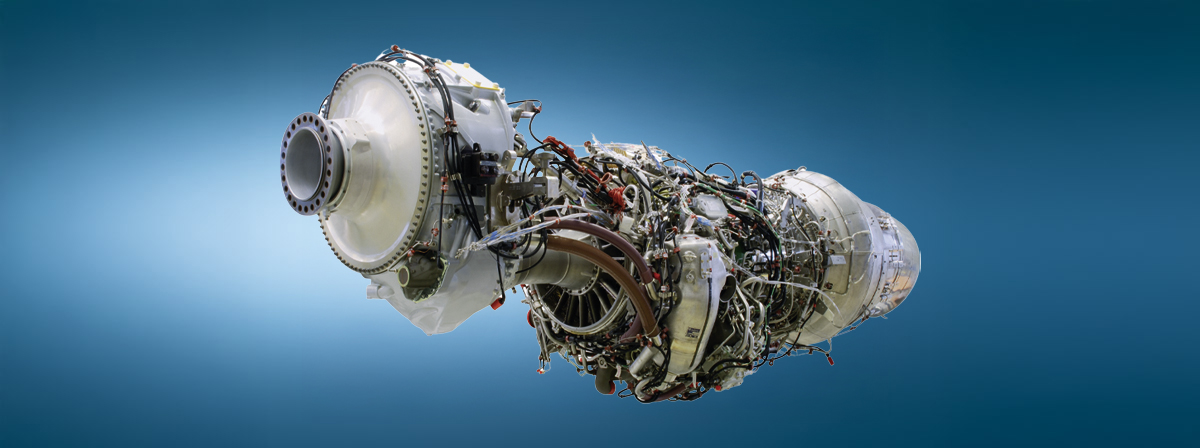
TP400-D6
- Type:
- three-shaft turboprop
- Power (at sea level):
- 11,000 shp
- Pressure ratio:
- 25:1
- Propeller diameter:
- 17.4 ft
- Program share (MTU):
- 22,2% - Development and production of intermediate-pressure compressor, intermediate-pressure turbine and intermediate-pressure shaft
"And that’s exactly what the A400M is: an exceptionally versatile flying heavy-lift transporter."
Andreas Spaeth
Aviation journalist Andreas Spaeth recalls
Initially, the A400M struggled with its reputation. But with each of its appearances at international aviation exhibitions, such as the ILA in Berlin, appreciation for the aircraft grew. Its powerful turboprop engines, the distinctive sound of their four propellers, the aircraft’s steep flight maneuvers, and its extremely short takeoff and landing distances proved increasingly impressive—to me, too.
I was particularly fascinated by its twelve-wheel main landing gear; in comparison, the C-130 Hercules has just four wheels. This means the A400M can take off and land even on gravel runways or the beach. And although many aircraft can theoretically taxi backwards, the precision and control with which the A400M does this, with its engines running and in the tightest of spaces, is unique.
I was also impressed by its interior: it’s just a few steps up to the spacious cockpit, which offers a wide view over the apron. Not quite as high up as the cockpit of a jumbo jet, but comparable to the perspective from the driver’s cab of a large truck. And that’s exactly what the A400M is: an exceptionally versatile flying heavy-lift transporter.
FAQ
Why is the Airbus A400M considered the successor to the Transall C-160?
The A400M represents a quantum leap forward from its predecessor the Transall, which dates back to the 1960s. The A400M is significantly larger, faster, and more powerful; crews can load over twice as much equipment and cargo through the rear ramp into the fuselage. It can also handle long-haul flights and be used for in-flight refueling.What makes the Airbus A400M’s TP400-D6 engine special?
To meet the A400M’s unique requirements, the TP400-D6 features advanced aerodynamics and component design, low fuel consumption, low weight, and efficiency across a broad operating range encompassing everything from prolonged low-altitude flights to high cruising speeds. It also boasts integrated engine and propeller control.What role does MTU Aero Engines play in the TP400-D6 engine for the A400M?
MTU is responsible for the TP400-D6’s intermediate-pressure compressor, intermediate-pressure turbine, and intermediate-pressure shaft, and it is also involved in the control system. In addition, MTU Aero Engines in Munich handles final assembly for all TP400-D6 production engines, and MTU Maintenance Berlin-Brandenburg performs the production acceptance tests on the world’s only production test stand for A400M engines.How can the Airbus A400M take off and land on unpaved runways?
The robust landing gear, with a total of twelve wheels on each side, distributes the aircraft’s weight. As a result, pressure on the ground is low, and the aircraft doesn’t sink into it. The landing gear’s sturdy construction absorbs shocks on uneven ground, and the four engines are mounted up high enough to protect them from damage caused by any dirt or foreign objects that may be whipped up. The A400M doesn’t depend on any external equipment for agility on the ground; using thrust reversers, it can even maneuver backward.How is the Airbus A400M used in evacuation and relief missions?
The A400M’s design and size make it extremely versatile. In the summer of 2026 alone, it flew relief missions for the German Air Force in the earthquake-stricken region of Venezuela and firefighting missions for the French Air Force to combat wildfires. The aircraft can evacuate hundreds of people in one go if necessary, it can land and operate on the ground even in poor visibility, and it can be converted into a flying intensive care unit. It meets all the requirements for transporting heavy equipment as well as for airdropping relief supplies, as it has done over the Gaza Strip.What countries use the Airbus A400M?
As of July 2026, a total of 138 A400M aircraft had been delivered: The German Air Force has received 53, France operates 25, the United Kingdom 22, Spain 14, and Turkey 10. Four other air forces, including those of Kazakhstan and Malaysia, also operate the A400M.