From engine-driven generators to emergency turbines: How an aircraft is supplied with electricity—and why every kilo counts on board.
More than just thrust – how engines provide electricity
- More than just thrust – how engines brake
- More than just thrust – how engines ensure cabin comfort
- More than just thrust – how engines provide electricity
- More than just thrust – how engines control hydraulics
What would an aircraft do without engines? One thing’s for sure: It wouldn’t fly. But modern jet engines achieve far more than just propulsion. They brake during landing, supply the cabin with air and heat, generate electricity for the avionics, and drive hydraulic systems. In other words, they are the power backbone for flight operations—performing functions that are essential to safety, comfort, and efficiency. This installment looks at how engines generate electricity—and what makes the on-board electrical system a technical masterpiece.
A modern airliner is full of electrical consumers—from the weather radar in the nose to the instruments in the cockpit and the reading light at passengers’ seats. But every kilo counts on board, and space is at a premium. There just isn’t enough room for large batteries. That’s why engine-driven generators produce electricity during the flight.
“They are typically connected to the high-pressure compressor shaft. The aircraft manufacturer specifies how much electrical power is required at various operating points. We then design the generators accordingly. Usually, the designers opt for three-phase generators with star-connected stator windings.”
Christopher Simson
MTU engineer in predesign for commercial and military programs
The aircraft’s electrical system typically operates at 115 volts and 400 hertz. Why not 50 or 60 hertz, like in family homes? Because when the frequency is higher, the transformer requires less metal and fewer windings, making it much smaller and lighter. However, certain avionics systems or the emergency power supply require direct current—and this is why there are also transformer rectifiers on board.
When the aircraft is on the ground, it usually draws electricity from a ground power unit (GPU), which converts the local mains voltage into the on-board voltage. Alternatively, a small engine in the rear of the aircraft called the auxiliary power unit (APU) can generate electricity—both on the ground and in the air.
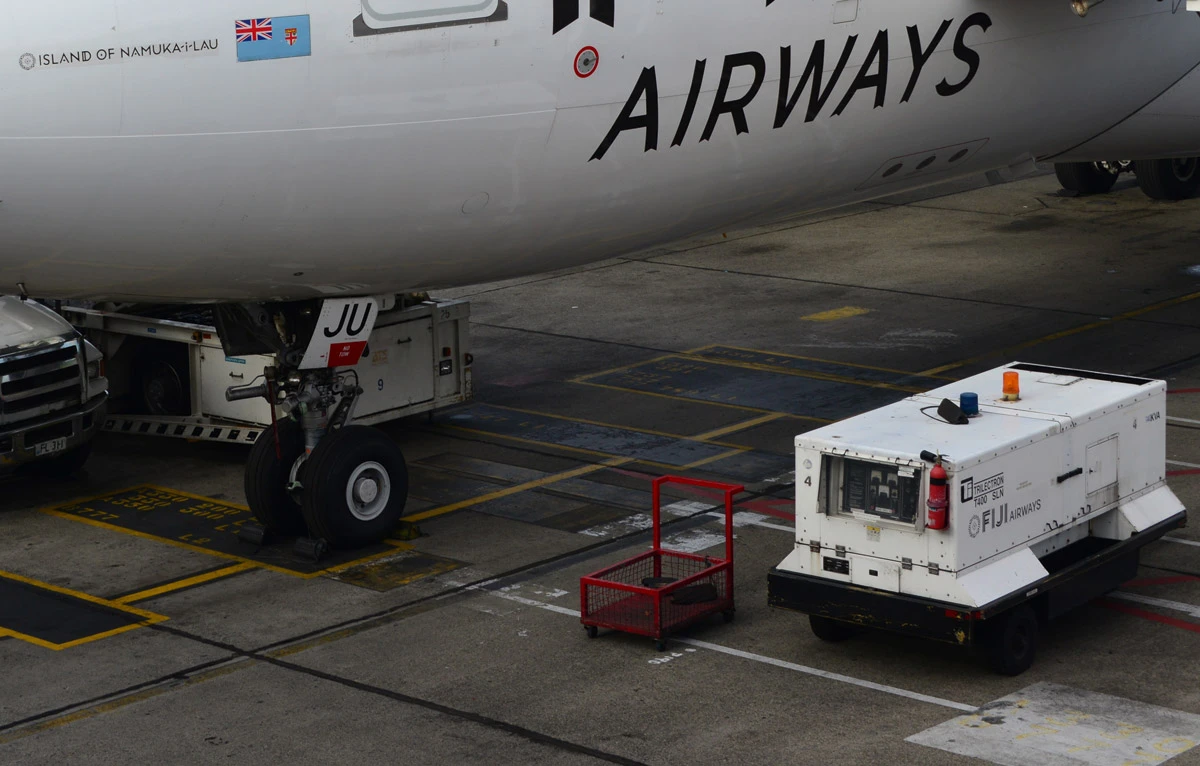
On the ground, a ground power unit (GPU) supplies the aircraft with electrical power. It provides energy for onboard electrical systems as long as the engines are shut down.
Generating power in an emergency
Modern aircraft are built to withstand even a complete power failure. Should one occur, the first step is for essential functions such as flight instruments, communication, and emergency lighting to switch to an emergency battery. This battery compensates for a power loss in microseconds and typically lasts 20 minutes. As a last resort, the ram air turbine (RAT) can be folded out mechanically. Driven by the airstream, this turbine supplies power for important systems such as the fly-by-wire control system. By this time, the pilots will have long since initiated an emergency landing at the nearest airport.