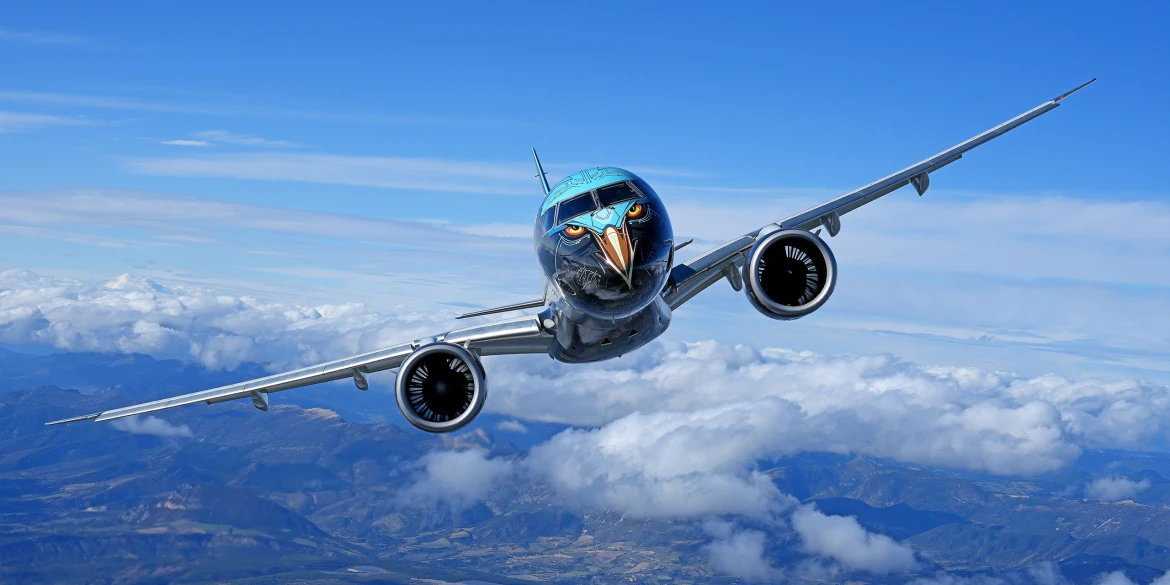
The Embraer E-Jet E2’s state-of-the-art geared turbofans make it one of the most efficient and comfortable regional jets in its class.
Embraer E-Jet E2 – A game changer for regional routes
©Embraer
- Boeing 747: Queen of the Skies
- The Boeing 737: How a simple jet revolutionized aviation
- Airbus A400M – modern military transporter and all-around talent
- Airbus A220 – The innovative medium-haul jet from Canada
- Boeing 777X – the largest twin-engine jet in the world
- Airbus A321XLR: A new chapter for aviation
- The Airbus A380 – the world’s largest passenger aircraft
- Airbus A319 – a small aircraft for a wide range of tasks
- Airbus A320 – a medium-haul bestseller for almost 40 years
- Embraer E-Jet E2 – A game changer for regional routes
- Boeing 787 – into the 21st century with the Dreamliner
A comfortable and economical regional jet—in the late 1990s, that’s what Basel-based Crossair, at the time Europe’s leading regional airline, was looking for. And Moritz Suter, the company’s visionary founder, found precisely the partner he needed in Embraer, a rising Brazilian aircraft manufacturer. “No middle seats” was one of his key requirements. Until then, Embraer had built only smaller regional jets. However, with the development of the E-Jet family at the start of the new millennium, the Brazilians laid the foundation for one of their most successful programs.
In 2004, it was LOT Polish Airlines, as the launch customer, that ushered in the era of larger regional jets from Brazil. These aircraft, with 80 to 120 seats, have been impressing passengers with their comfort ever since—in large part because, by doing away with middle seats, they outshine many larger narrowbody aircraft. By 2026, Embraer had sold more than 1,750 E-Jets.
The geared turbofan triggers a quantum leap
About a decade after the first generation of E-Jets took to the skies, the decision to combine the proven platform with new geared turbofan engines brought a significant leap in efficiency: up to 30 percent lower fuel consumption, lower noise and emissions levels, and a longer range (compared to the previous version). Right from the start, demand was particularly high for the biggest model, the E195-E2, which can accommodate up to 146 passengers and has a range of approximately 5,600 kilometers. Even before its maiden flight on May 23, 2016, it had attracted more than 260 orders. The first airline to operate it was Norway’s Widerøe, which established its first jet fleet with the E195-E2 in 2018.
By mid-2026, 203 E2s had been delivered and more than 500 orders had been received in total. The South African airline Airlink uses the aircraft on routes including the one between Cape Town and Mauritius. Up to 124 passengers can travel the approximately six-and-a-half-hour route in a two-class configuration. “For us, the E2 is a game changer in terms of range and seating costs,” says Airlink CEO Engelbrecht de Villiers.

©Andreas Spaeth
©Andreas Spaeth
©Andreas Spaeth
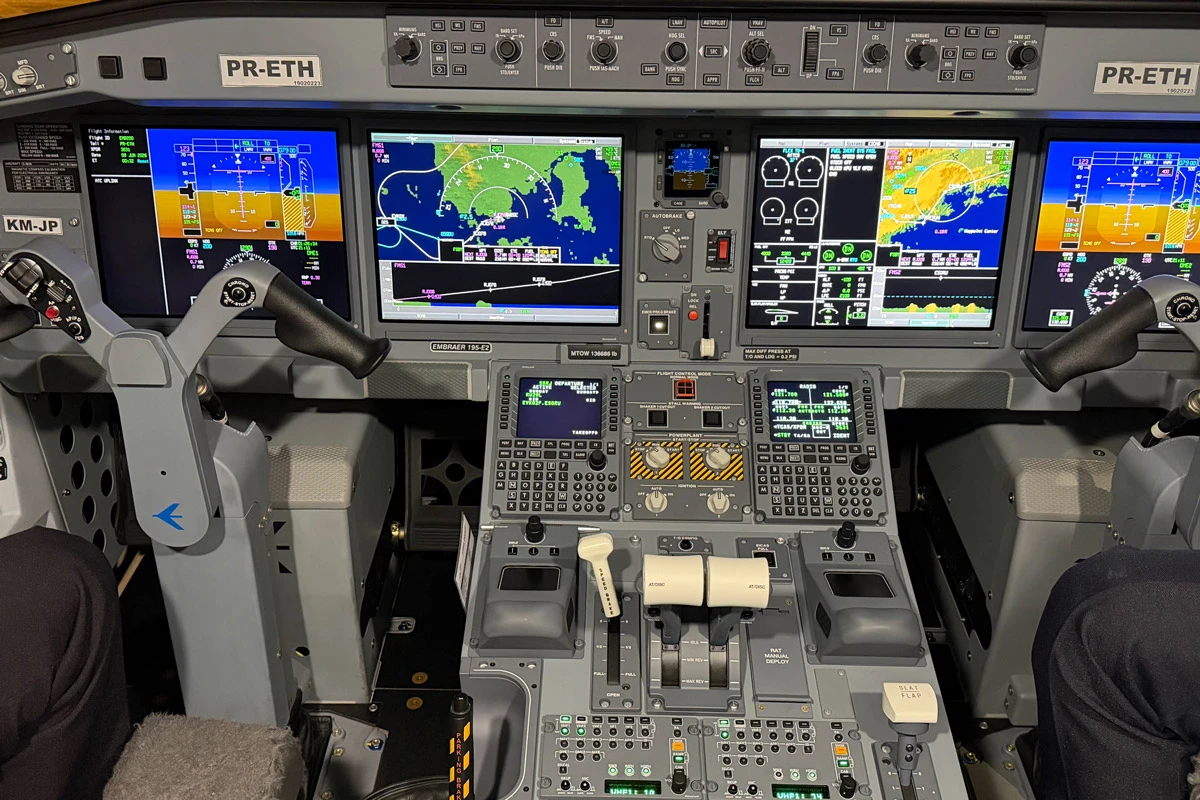
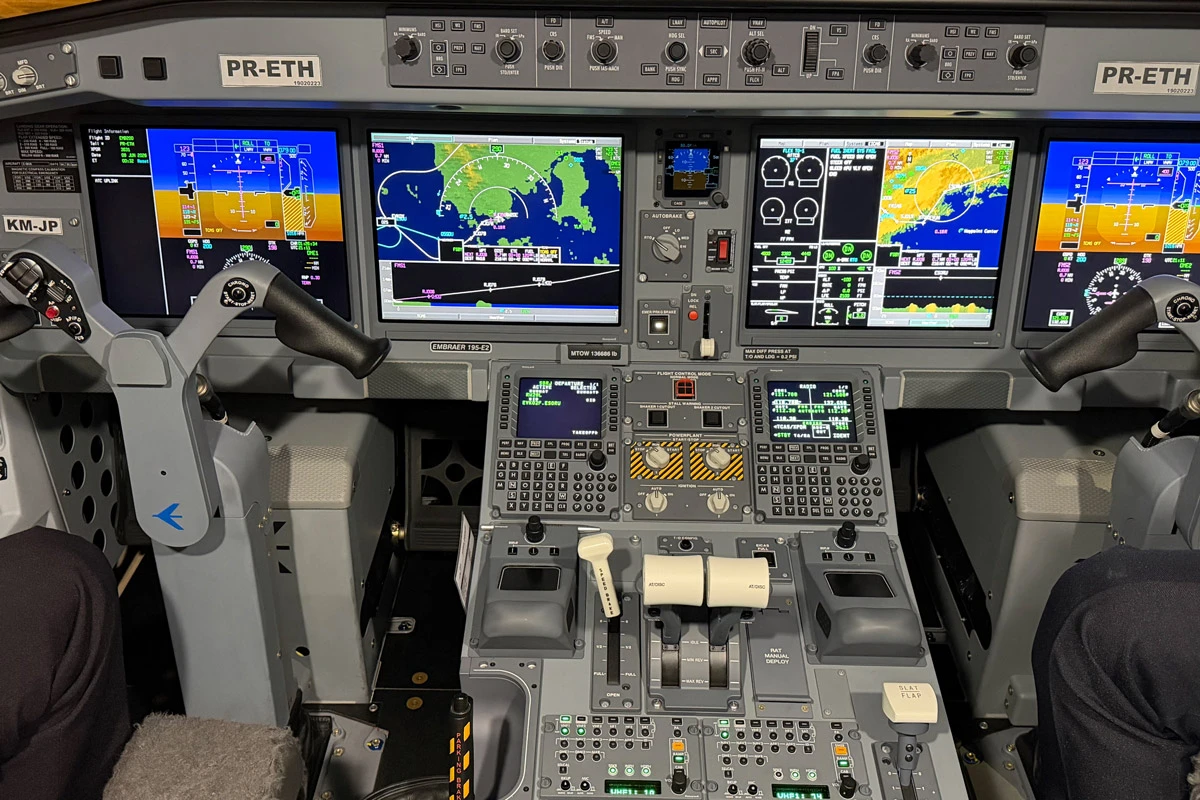
The E190-E2 and E195-E2 feature a special steep-approach function, activated via the Steep Approach button.
©Embraer
©Embraer
©Embraer
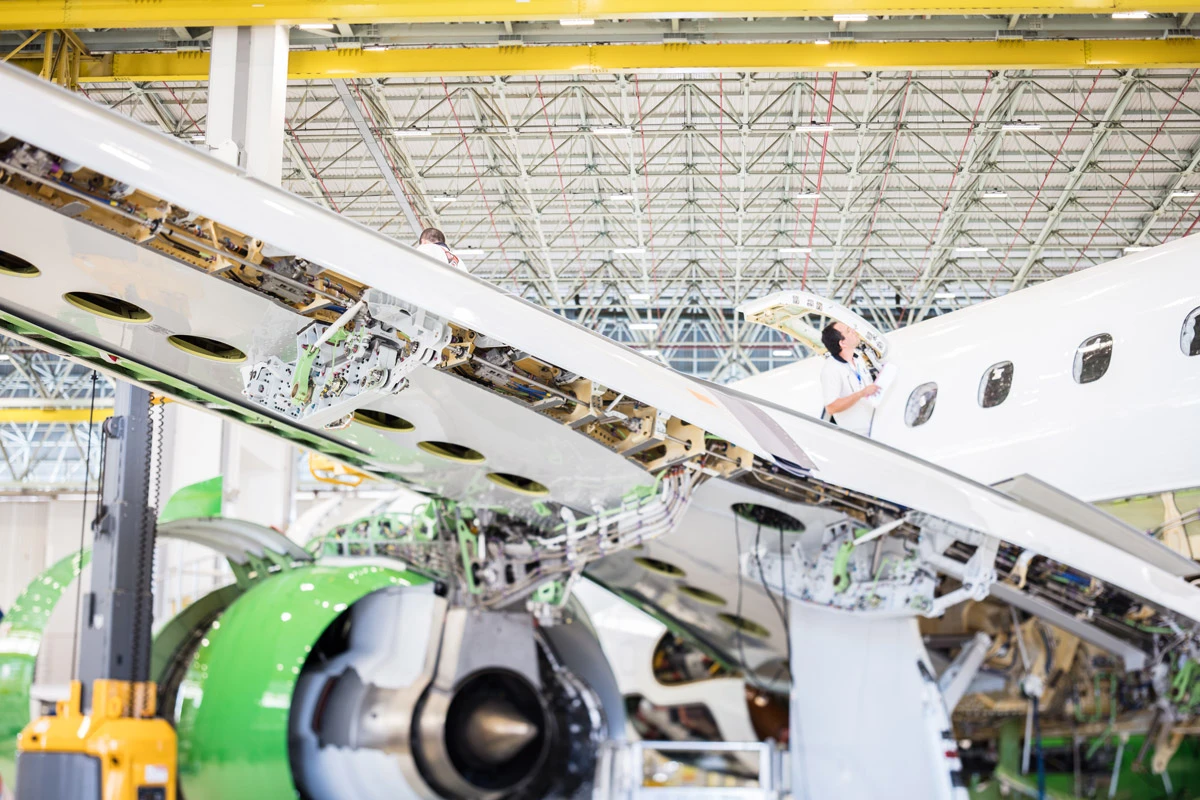
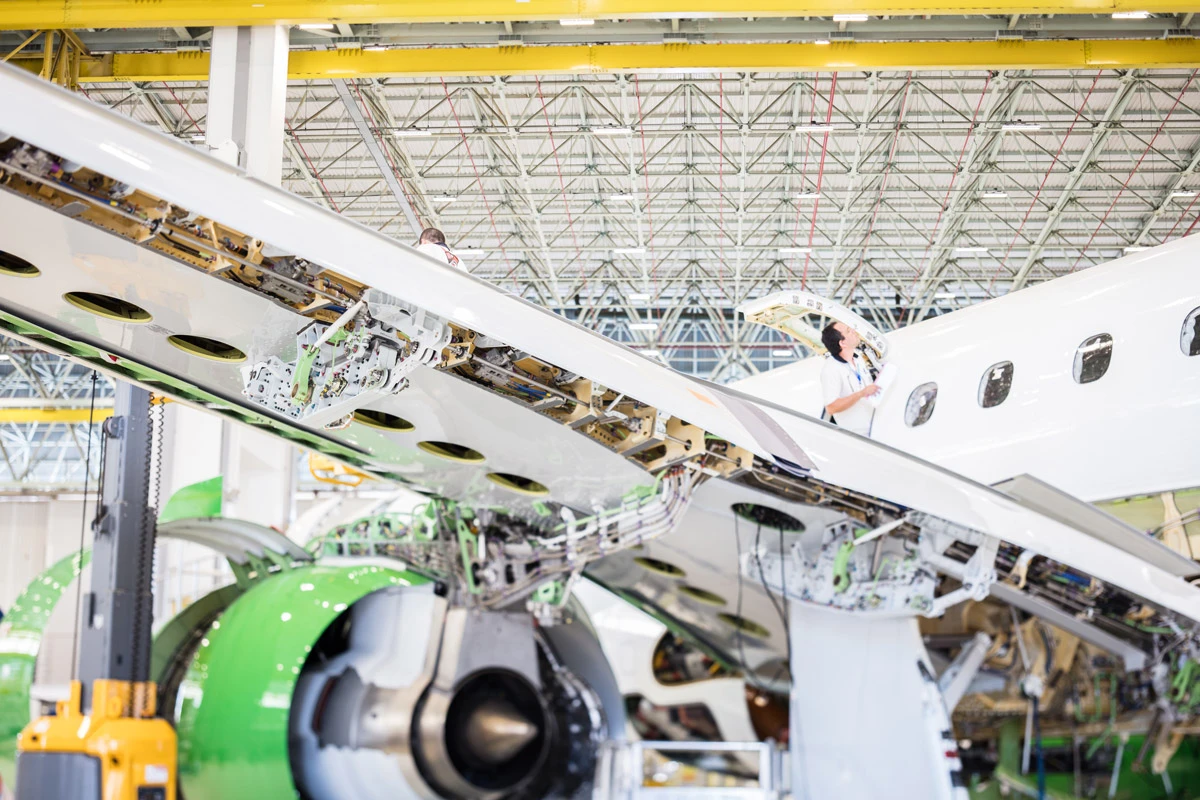
All E-Jets are manufactured at the Embraer plant in São José dos Campos, about 100 kilometers from São Paulo, Brazil.
Embraer E-Jet E2 – Facts, figures, dates
-
For the two variants of the Embraer E2, geared turbofan engines from Pratt & Whitney are the only engine option. The E190-E2 (maximum 114 seats) and the E195-E2 (maximum 146 seats) are powered by the PW1900G.
-
For the E2, Embraer refined the existing E Jet platform extensively, giving it new composite wings, a higher landing gear configuration to accommodate the bigger engines, a smaller tail assembly, and a modernized fly-by-wire control system.
-
The increased engine power paved the way for longer fuselages. On the E195-E2, the fuselage was lengthened by just under three meters compared to the original version, creating space for three additional rows of seats.
-
The E190-E2 and E195-E2 feature a special steep-approach function. It allows for approach angles of up to 5.5 degrees, which is crucial at airports such as London City Airport. Once the pilot activates it using the Steep Approach button, the fly-by-wire software adjusts the configuration of the control surfaces, flaps, and spoilers.
-
In the spring of 2026, the largest E2 operators were Canada’s Porter Airlines (52 aircraft), Brazil’s Azul (43), and the Netherlands’ KLM Cityhopper (25).
-
All E-Jets are manufactured at the Embraer plant in São José dos Campos, about 100 kilometers from São Paulo, Brazil.
Embraer E195-E2
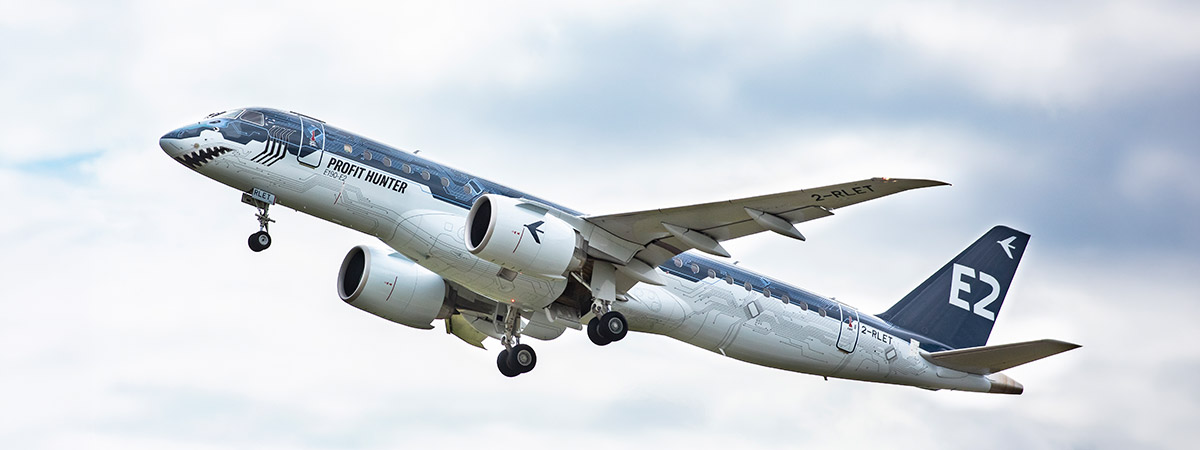
Embraer E195-E2
©Andreas Spaeth
- Type:
- Twin-engine short-haul aircraft
- Manufacturer/origin:
- Embraer, São José dos Campos, Brazil
- Maiden flight:
- May 23, 2016
- Entry into service:
- April 24, 2018
- Produced:
- 2016–today
- Number built:
- 203 (through June 2026)
- Length:
- 41.51 meters
- Wingspan:
- 35.12 meters
- Range:
- 5,600 kilometers
- Cruising speed:
- 833 km/h
- Seats (typical/maximum):
- 120/146
You may also be interested in:
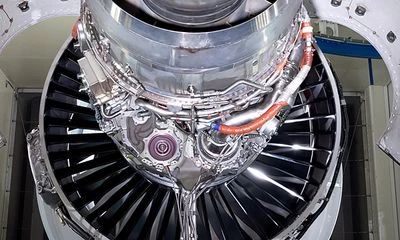
The Embraer E2 engine: PW1900G
The PW1900G is a Pratt & Whitney geared turbofan engine that was specially developed for Embraer’s E-Jets. Its reduction gearbox located between the fan and low-pressure compressor—on which the low-pressure turbine that drives the fan is mounted—allows the fan to rotate more slowly. At the same time, the low-pressure compressor and turbine can run faster. This helps achieve lower fan pressure ratios, and thus higher bypass ratios, and lets all components achieve their optimum performance. Consequently, the PW1900G has very high overall efficiency, substantially reducing fuel consumption and CO2 emissions and significantly decreasing noise footprint.
MTU has a 15 percent share in the PW1900G program, with responsibility for developing and manufacturing the high-speed low-pressure turbine as well as the first four stages of the high-pressure compressor. MTU is also responsible for the maintenance of the PW1900G via EME Aero in Poland, its joint venture with Lufthansa Technik.
PW1900G
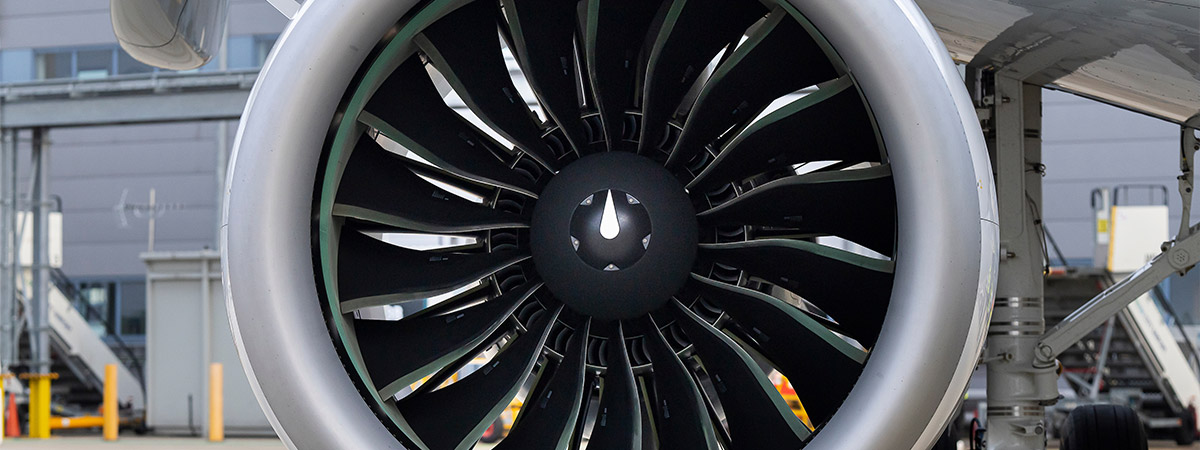
PW1900G
©Andreas Spaeth
- Type:
- Two-shaft turbofan engine
- Thrust (pounds):
- 19–23 t
- Bypass ratio:
- 12.5:1
- Fan diameter:
- 1.85 m
- MTU program share:
- 15 percent – development and manufacture of various stages of the high-pressure compressor, the high-speed low-pressure turbine, and brush seals for all applications
Aviation journalist Andreas Spaeth recalls
My second flight on an Embraer E2 was a special one: the aircraft’s first visit to London City Airport. This inner-city airport in London’s Docklands is authorized to handle only certain types of aircraft due to the steep approach required for noise abatement. Since September 2, 2021, that has included the E2.
On approach, the aircraft descends at a rate of up to 1,200 feet (365 meters) per minute instead of the usual 800 feet (244 meters). This shortens the final approach from about 13 kilometers to just under 5. The ability to perform steep approaches stems from requirements set by Crossair, the first customer to order E-Jets; the Swiss airline was also looking to serve challenging airports such as Lugano, Sion, and Florence.
In 2021, in the middle of the coronavirus pandemic, I was given a rare opportunity to take part in this aircraft’s first flight into London City, flying with Helvetic Airways from Zurich. Both the steep approach and the powerful takeoff made quite an impression. “It’s very comfortable to fly,” said the chief pilot, pointing to the Steep Approach button located to the left of the thrust levers on the center console.
FAQ
What makes the Embraer E-Jet E2 an efficient regional jet?
Thanks in large part to the new geared turbofan engines, the E2 offers a combination of impressive range and low seating costs that’s attractive to many operators. The lighter fuselage and the smaller horizontal stabilizer mean that less engine thrust is required during takeoff and climb, which results in lower fuel consumption. The fuselage’s state-of-the-art aerodynamics and new wings also ensure greater efficiency.How does the Embraer E195-E2 differ from the first generation of E-Jets?
The key innovation in the E2 is its geared turbofan engines, which reduce fuel consumption and CO2 emissions by up to 20 percent per seat compared to the first generation. The new, slimmer wings made of composite material—with a wingspan that’s a good six meters longer—play a role here, too. Other distinguishing features include a higher landing gear configuration and a longer cabin that can accommodate up to three additional rows of seats.What does it mean that the Embraer E-Jet E2 has “steep approach” capability?
Thanks to modifications to the fly-by-wire software, the E2 can approach runways at an angle that’s nearly twice as steep as usual—that is, at up to 5.5° instead of 3°. This is important for airports with short runways and strict noise regulations, such as London City Airport. Or at airports in mountainous areas, such as Sion in Switzerland, where the surrounding mountains require a steep approach.Why do Embraer E-Jets not have middle seats, and why is that important to airlines?
The decision to leave out the regional jet’s middle seats was primarily an effort to improve passenger comfort—and enhance the travel experience in this segment. It maximizes personal space in every seat without widening the fuselage. The lack of middle seats also speeds up boarding and deplaning, as well as the in-flight service.What role does MTU Aero Engines play in the PW1900G engine for the Embraer E2?
MTU Aero Engines holds a 15 percent stake in the PW1900G program. The engine manufacturer’s responsibilities include the development and production of the high-speed low-pressure turbine and the first four stages of the high-pressure compressor. MTU Aero Engines is also involved in the PW1900G in the area of maintenance, repair, and overhaul (MRO): Maintenance is performed at EME Aero in Poland, a joint venture between MTU Aero Engines and Lufthansa Technik.How do geared turbofan engines reduce fuel consumption, CO₂ emissions, and noise?
The core of the PW1900G is its reduction gearbox located between the fan and low-pressure compressor, on which the low-pressure turbine that drives the fan is mounted. It causes the fan to run more slowly, while the low-pressure compressor and turbine reach higher speeds. This helps achieve lower fan pressure ratios, and thus higher bypass ratios, and lets all components achieve their optimum performance. That in turn increases the overall efficiency of the PW1900G and reduces fuel consumption and CO2 emissions by up to 20 percent per seat kilometer, as well as the noise footprint by 75 percent.What airlines operate the Embraer E2, and on what routes does it really shine?
As of May 2026, 24 airlines from 23 countries across all continents were flying the E2; Porter Airlines from Canada operates the most, followed by Azul from Brazil and KLM Cityhopper from the Netherlands. The portfolio ranges from 40-minute regional hops to medium-haul routes, such as Lagos–Johannesburg (4,500 kilometers, travel time 6 hours, 20 minutes), or transcontinental flights in North America such as Toronto to San Francisco (3,600 kilometers; 5 hours, 52 minutes).